Food-Grade PHE Gaskets: FDA Compliance Guide
Food-Grade PHE Gaskets: FDA Compliance for Dairy, Beverage & Pharma
A dairy plant and a brewery can use the same sentence, "we need a food grade heat exchanger gasket," and mean different document sets: one audited against 3-A, one against a retailer spec. Both ask for paper the gasket does not carry.
FDA Does Not Certify Gaskets
There is no FDA certificate for an elastomer gasket. Compliance is a claim about a compound: which ingredients it contains, under which regulation, and what it releases when extracted. A buyer receives a supplier declaration, a formulation assessment and an extraction report. "All our gaskets are FDA approved" is none of those three.
The 21 CFR 177.2600 Gasket Rules
For rubber in repeated food contact, the regulation lists permitted ingredients and caps extractives on the finished article. In distilled water at reflux, the food-contact surface may release no more than 20 mg per square inch in the first 7 hours, and 1 mg per square inch in the next 2. For fatty food the test switches to n-hexane, at 175 and 4 mg per square inch. So the question about any FDA compliant gasket material is not "is it approved" but "aqueous or fatty duty, at what temperature."
Choose the Compound, Not the Colour
A food grade EPDM gasket covers most aqueous duty, milk to juice to CIP circuits, to roughly 150 °C. NBR suits fat and oil, HNBR heat with oil, FKM where temperature or media rule out the rest. Colour proves nothing: a black compound can comply fully, a white one can fail on its cure system.
The Second Audit Layer
Dairy buyers usually add 3-A 18-03: plate gaskets fall in Class II, product contact to 121 °C, cleaning to 82 °C, with some at Class I and 149 °C. Pharma duty moves to USP <87>/<88> Class VI. In Europe, 1935/2004 and GMP 2023/2006 set the frame; elastomers sit on national lists such as BfR XXI.
What Changes on a Dairy Line
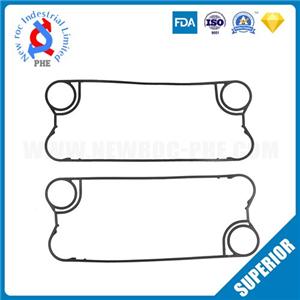
A dairy heat exchanger gasket meets caustic, acid and rinse every day at 80 to 85 °C. Compression set fails first, showing as port leaks after a few months; then the groove, where product sits behind a lifted gasket. Check that groove and clip are cleanable, not just sealed, and ask for compression set data.
The Document Set to Request
Five items cover the review: a declaration naming the compound code, the regulation relied on, the food type and temperature covered; the extraction report; a batch certificate tying delivered gaskets to that compound; and change control. Less than that is a slogan.
Send the duty, the medium and the cleaning regime to info@newroc-phe.com and we will match compound and paperwork to it.
FAQ
Q: Is FDA compliance the same as 3-A?
A: No. 177.2600 is a prerequisite of 3-A, which adds cleaning and sanitising tests.
Q: Can one gasket cover dairy and pharma?